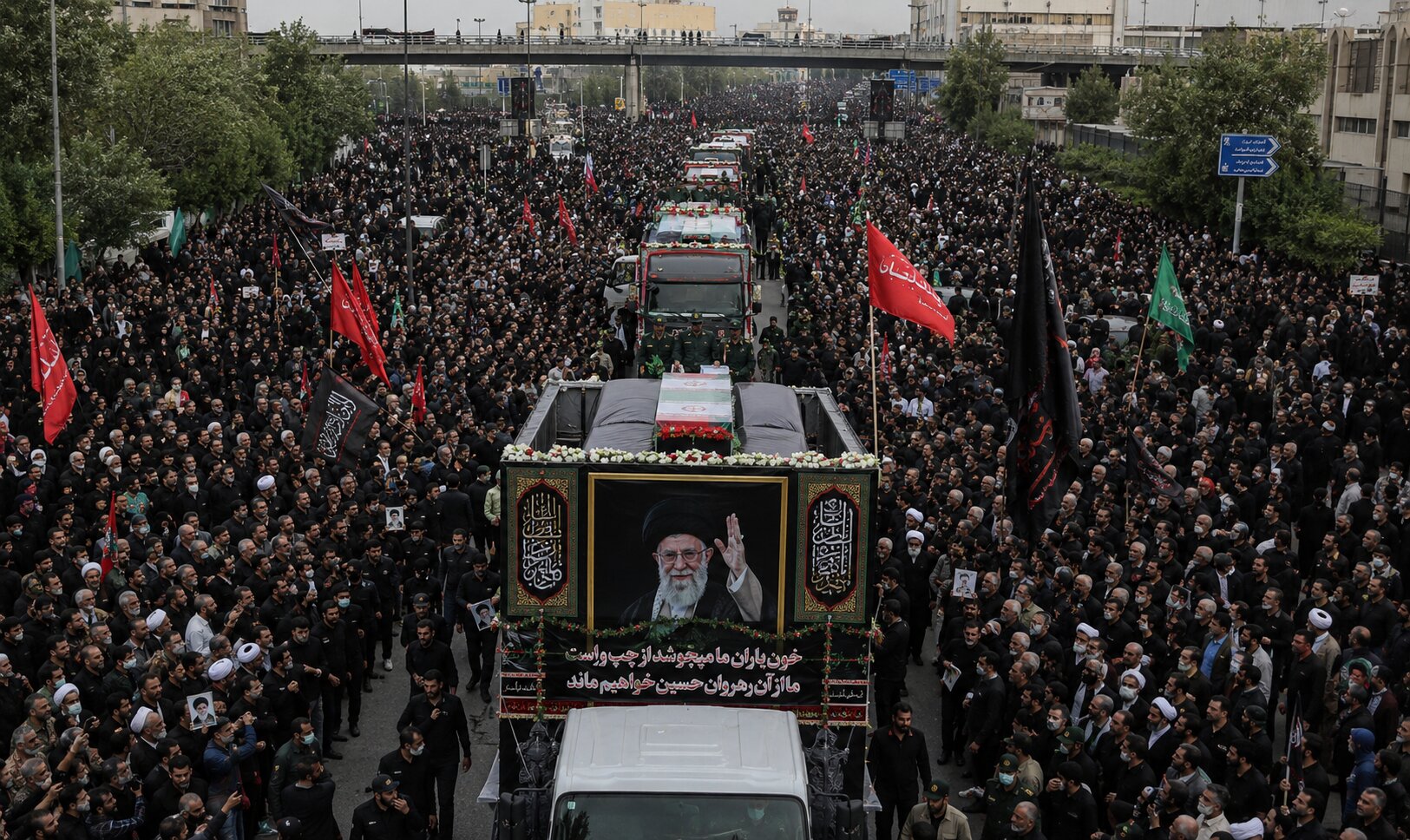








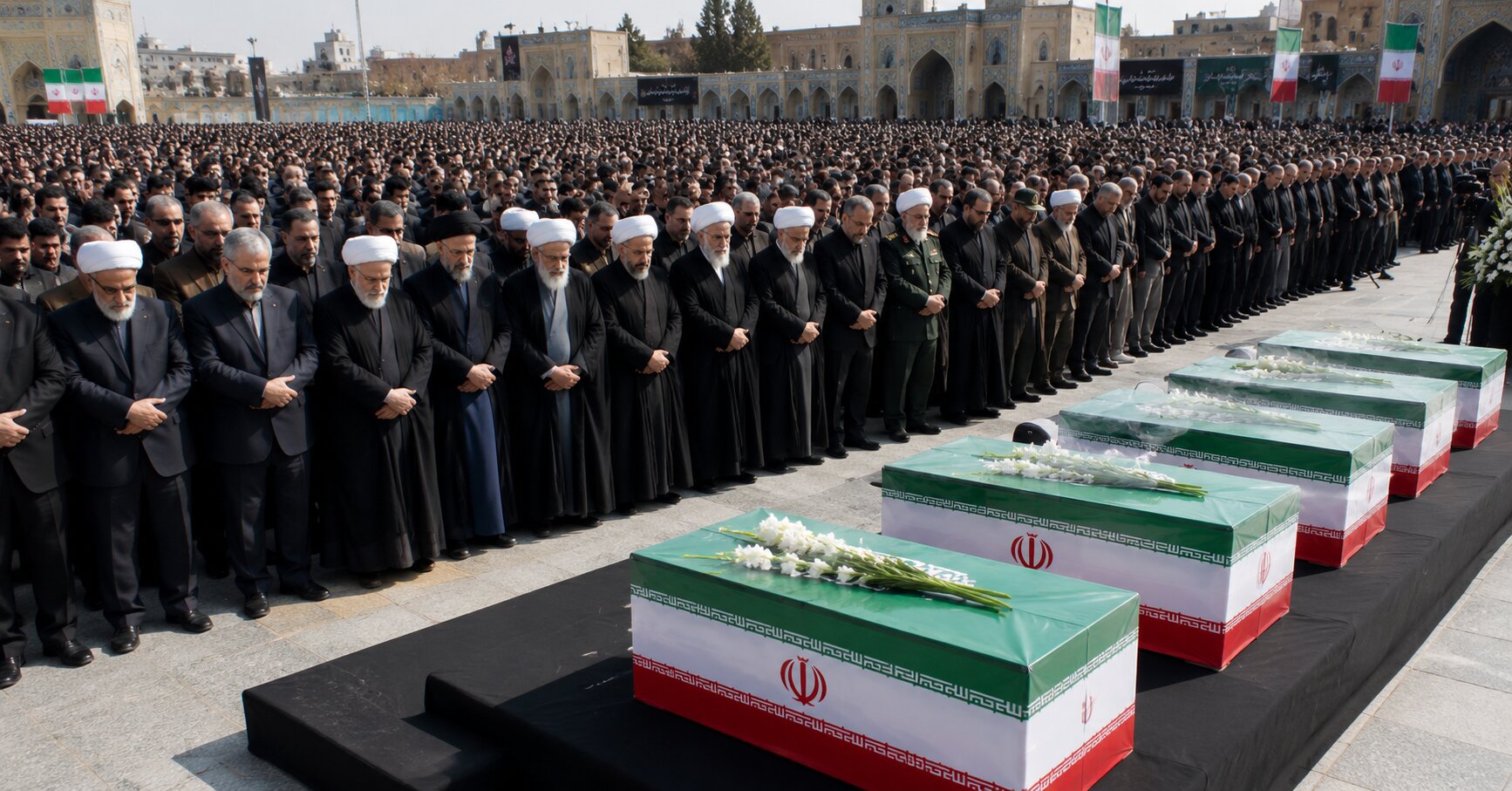
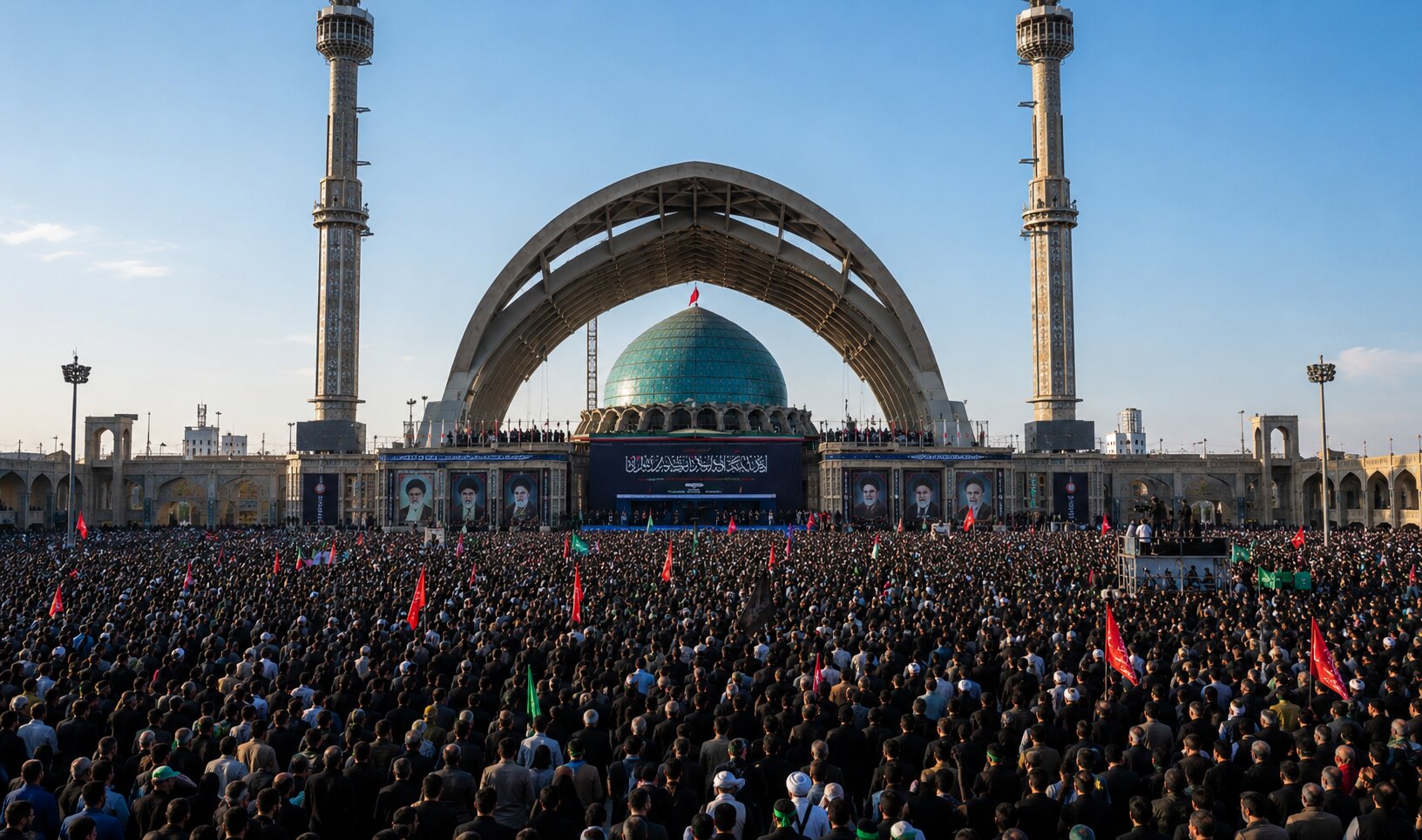
“The Khamenei funeral Tehran ceremonies drew millions of mourners from Iran and neighbouring countries on Sunday, as crowds gathered at Tehran’s Imam Khomeini Mosalla for funeral prayers for the country’s late Supreme Leader, Ayatollah Ali Khamenei. Senior cleric Ayatollah Jafar Sobhani led the prayers before massive crowds that filled the complex to capacity.”
As the prayer hall reached full capacity, all entrances were closed hours ahead of the ceremony. Streets and pathways surrounding the venue remained packed with mourners who were unable to enter but stayed to pay their respects from outside, many standing for hours in the summer heat as volunteers sprayed cooling water over the crowds.
A three-stage ceremony
The funeral prayers were held in three parts. The first was offered for Khamenei himself. The second covered three relatives who died in the same strike — Seyyedeh Boshra Hosseini Khamenei, Mesbah al-Hoda Baqeri, and Zahra Haddad Adel — while the third was dedicated to Zahra Mohammadi Golpayegani, Khamenei’s granddaughter.
The public farewell ceremony began early Saturday at the Grand Mosalla and continued into Sunday, drawing what Iranian officials estimate could be among the largest gatherings the country has seen since the 1989 funeral of Ayatollah Ruhollah Khomeini, which itself saw chaotic scenes as millions thronged the procession. Iran’s Health Ministry has said preparations for the current funeral had been underway for roughly a month, with temporary hospitals and medical teams stationed near the venue on standby.
Background: killed in the February war
Khamenei, who led Iran for more than three decades, was killed on February 28 at the outset of the war between Iran and a US-Israeli coalition. Several members of his family were reported killed in the same strike. His son, Mojtaba Khamenei, has since been named as his successor, though he has largely stayed out of public view since his appointment and was not expected to attend the funeral proceedings in person.
The loss of a Supreme Leader is only the second such transition in Iran since the 1979 Islamic Revolution, making the scale and symbolism of this funeral especially significant for the country’s political and religious establishment.
“As the Khamenei funeral Tehran proceedings continue this week, the main funeral procession in Tehran is scheduled for Monday.”
What comes next
The main funeral procession in Tehran is scheduled for Monday. Further ceremonies are planned in the holy city of Qom on Tuesday, before the procession crosses into Iraq, where additional farewell ceremonies will be held in Najaf and Karbala on Wednesday. The final procession is set for Thursday in Mashhad, where Khamenei will be laid to rest at the shrine of Imam Reza.
On Friday, foreign dignitaries — including Pakistani Prime Minister Shehbaz Sharif, former Russian president Dmitry Medvedev, a senior Chinese lawmaker, and representatives from Iraq and Afghanistan — attended tribute ceremonies in Tehran as Khamenei’s body lay in state.
India’s presence at the ceremonies
Among the foreign dignitaries confirmed to attend the funeral proceedings are Bihar Governor Lt Gen Syed Ata Hasnain and Minister of State for External Affairs Pabitra Margherita, representing India. Their attendance reflects the significant Shia community ties between India and Iran, as well as India’s broader diplomatic interest in regional stability given its energy imports and trade routes that pass through the Gulf region — an area directly affected by the recent Strait of Hormuz tensions.
Security concerns amid the mourning
Security has been tightened significantly around the funeral proceedings, with Iran’s Revolutionary Guard warning against any attempt to target the gatherings, which are expected to draw several million people over the course of the week. Israeli officials have separately said that Mojtaba Khamenei himself is being closely watched, adding a layer of tension to a period otherwise dominated by mourning and displays of national unity.
The scale of security preparations underscores the delicate moment Iran finds itself in — balancing a massive public outpouring of grief with the ongoing fragility of the ceasefire reached with the United States following the February conflict.