










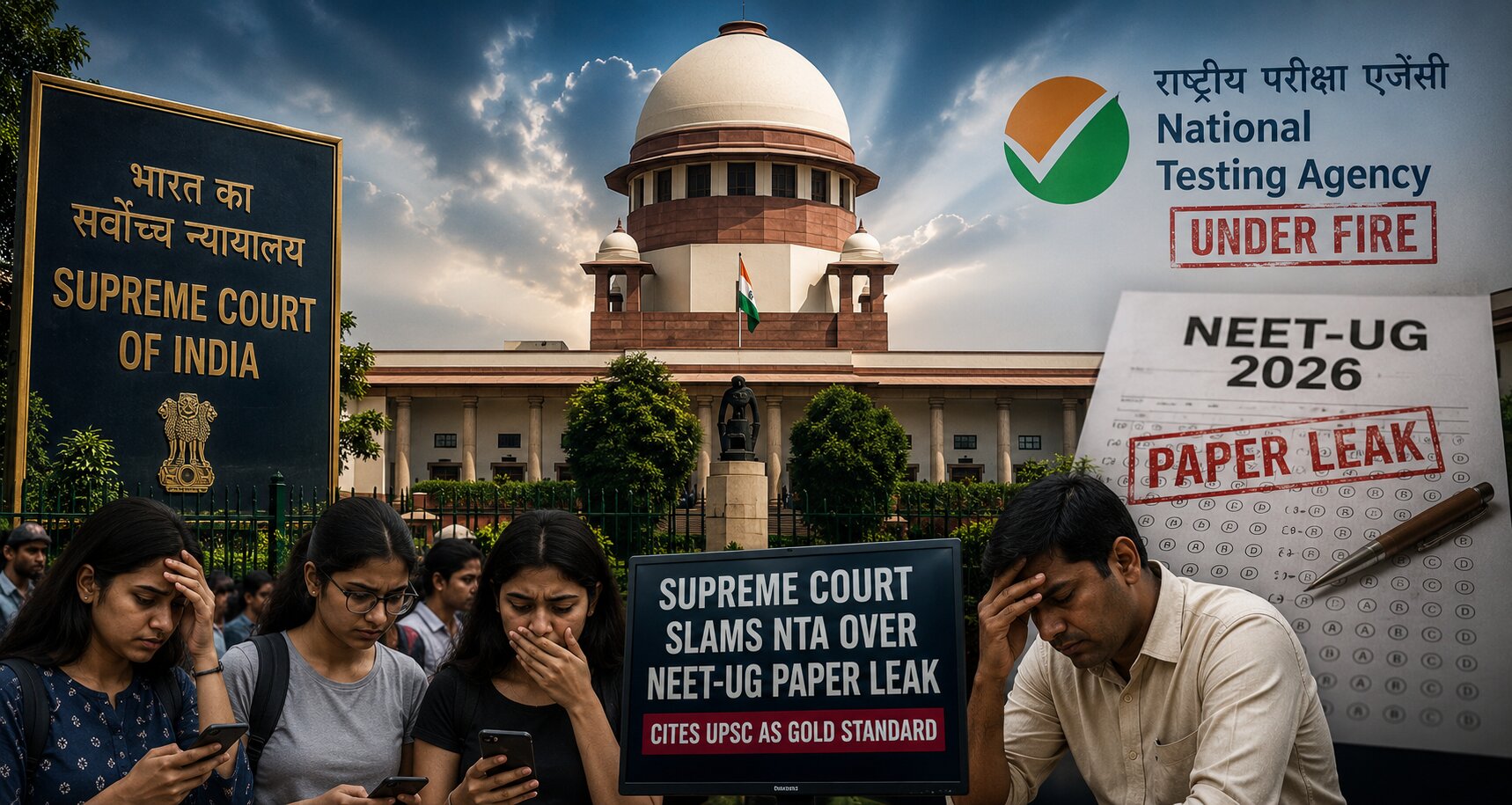
The Supreme Court has sharply criticised the National Testing Agency over the NEET-UG paper leak, questioning how multiple layers of security failed — and pointing to UPSC as a model that has never faced such a breach.
New Delhi, May 29, 2026 — The Supreme Court on Friday delivered a sharp rebuke to the National Testing Agency over the recurring NEET-UG paper leak controversy, questioning how a breach of this scale could occur despite the existence of oversight committees and monitoring mechanisms specifically designed to prevent it.
The bench, led by Justice P S Narasimha, drew a pointed comparison with the Union Public Service Commission, observing that India’s premier civil services examination had never experienced a paper leak of this nature. The court suggested the NTA had serious lessons to learn from the UPSC’s systems and processes.
Court Questions Depth of Monitoring
At the centre of Friday’s hearing was Dr K Radhakrishnan, former chairman of ISRO and head of the High-Level Committee formed to strengthen examination security. Solicitor General Tushar Mehta represented the NTA before the bench.
Justice Narasimha questioned Dr Radhakrishnan directly — noting that he had first served on the High-Powered Committee before being appointed to the monitoring committee — asking how much actual monitoring of implementation had taken place after the committee’s recommendations were submitted.
The court also pressed him on what the committee had failed to anticipate, given that the leak occurred even after safeguards had been recommended and supposedly put in place.
101 Recommendations, 60 Already Implemented
Dr Radhakrishnan informed the court that the committee had submitted a total of 101 recommendations to overhaul examination security and administration. Of these, 60 were short-term recommendations targeted specifically at the 2025-26 examination cycle.
He stated that most recommendations had already been implemented, with the remaining ones currently in progress. A secured testing implementation framework had been initiated, and he described the cumulative effect of these changes as a “phenomenal improvement” in examination systems.
On the specific question of how the leak occurred, Dr Radhakrishnan pointed to weaknesses in the question paper setting process — an area he said was now being actively strengthened.
“Our target is reform,” he told the court.
Accountability, Not Just Reform, Says Court
The Supreme Court made clear that structural reforms alone would not be sufficient. The bench observed that the deeper problem would persist until genuine accountability was established within the system.
The judges clarified that accountability did not mean identifying and punishing a single individual. Rather, the court stressed that institutional responsibility needed to be fixed — that systems and the people overseeing them must be held answerable when failures of this magnitude occur.
The court took on record affidavits filed by both the NTA and Dr Radhakrishnan, while granting the central government additional time to file its response.
What This Means for Students
The NEET-UG paper leak has shaken confidence in one of India’s most high-stakes examinations, which determines admission to medical colleges across the country. Millions of students appear for the test each year, and the leak has raised serious questions about fairness, institutional integrity and the future of centralised competitive examinations in India.
With the Supreme Court now monitoring the situation closely and pressing for accountability at the institutional level, pressure is mounting on the NTA to demonstrate that the reforms being implemented will deliver results — and that a repeat of this controversy will not occur in the upcoming re-test.